Energy transition discussions are frequently shaped by simplified narratives that isolate individual technologies rather than considering the system as a whole. Existing tools often present static data or dense dashboards, making it difficult to explore “what-if” scenarios or understand the consequences of different decisions.
As a result, stakeholders struggled to:
interpret fragmented and technical data
Compare trade-offs across cost, emissions, and reliability
understand how changes in one area affected the wider system
Frazer-Nash needed a way to make these interdependencies visible, navigable, and open to exploration.
My Role
Visualizing Australia’s Energy Landscape
2025 ·
3591
The final outcome was an interactive prototype that enabled stakeholders to explore energy transition scenarios in real time. By making system relationships visible and navigable, the tool supported clearer understanding of complex trade-offs and encouraged more informed discussions around energy futures.
This project reinforced the importance of designing for systems rather than isolated interfaces. It demonstrated how interaction and visual structure can help make complex and abstract problems more approachable without oversimplifying them.
Reflection
Node-based visualisation
A node-based structure was used to represent energy sources and their relationships. This allowed interdependencies to be communicated spatially, making it easier to see how changes in one part of the system influenced others
Scenario exploration through interaction
Interactive controls were introduced to allow users to adjust energy inputs and explore different scenarios dynamically. This shifted the experience from passive viewing to active exploration, enabling stakeholders to test assumptions and compare outcomes.
Surfacing trade-offs
The interface was designed to make trade-offs across cost, emissions, and system reliability visible without prioritising a single metric. This supported more nuanced discussions and avoided overly simplified conclusions.
System Mapping
Early work focused on mapping the energy transition as a connected system rather than a linear flow. Relationships between generation sources, storage, emissions, cost, and reliability were explored through iterative system maps.
These mappings helped surface key dependencies and informed the underlying structure of the visual model, ensuring the design reflected system behaviour rather than isolated metrics.
Key Design Decisions
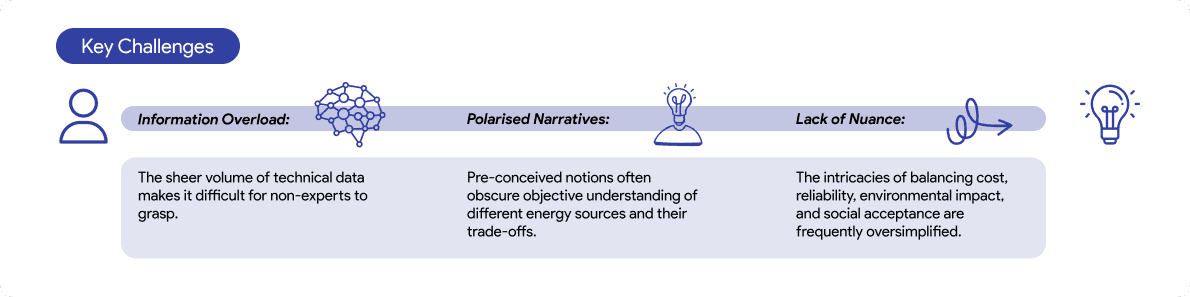
The Problem
Approach
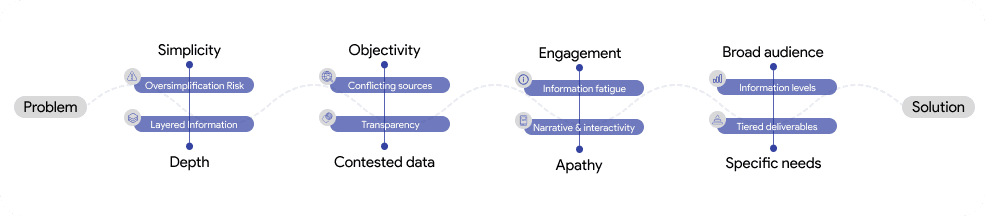
The project was approached through a systems-thinking lens, focusing on relationships rather than individual data points. Instead of reducing complexity early, the goal was to preserve it while making it easier to reason about and explore.
The design process prioritised understanding how different energy sources, constraints, and outcomes interact, and how these relationships could be expressed through visual structure and interaction.
An interactive, data-driven tool designed to help stakeholders explore complex energy transition scenarios and key trade-offs.